Regenerative medicine is rapidly evolving, bringing new therapeutic approaches and increasingly sophisticated clinical workflows into modern practice. As regenerative procedures become more specialized, healthcare professionals need efficient systems that support consistency, documentation, patient safety, and quality care.
Workflow optimization for regenerative medicine procedures provides a structured approach to organizing the clinical process from patient assessment through treatment, documentation, and follow-up.
A well-designed workflow does more than save time. It can help practitioners reduce unnecessary steps, improve communication, standardize procedures, and create a more consistent patient experience.
For clinicians and healthcare professionals pursuing advanced regenerative medicine education, understanding workflow design is an important part of developing a modern practice.
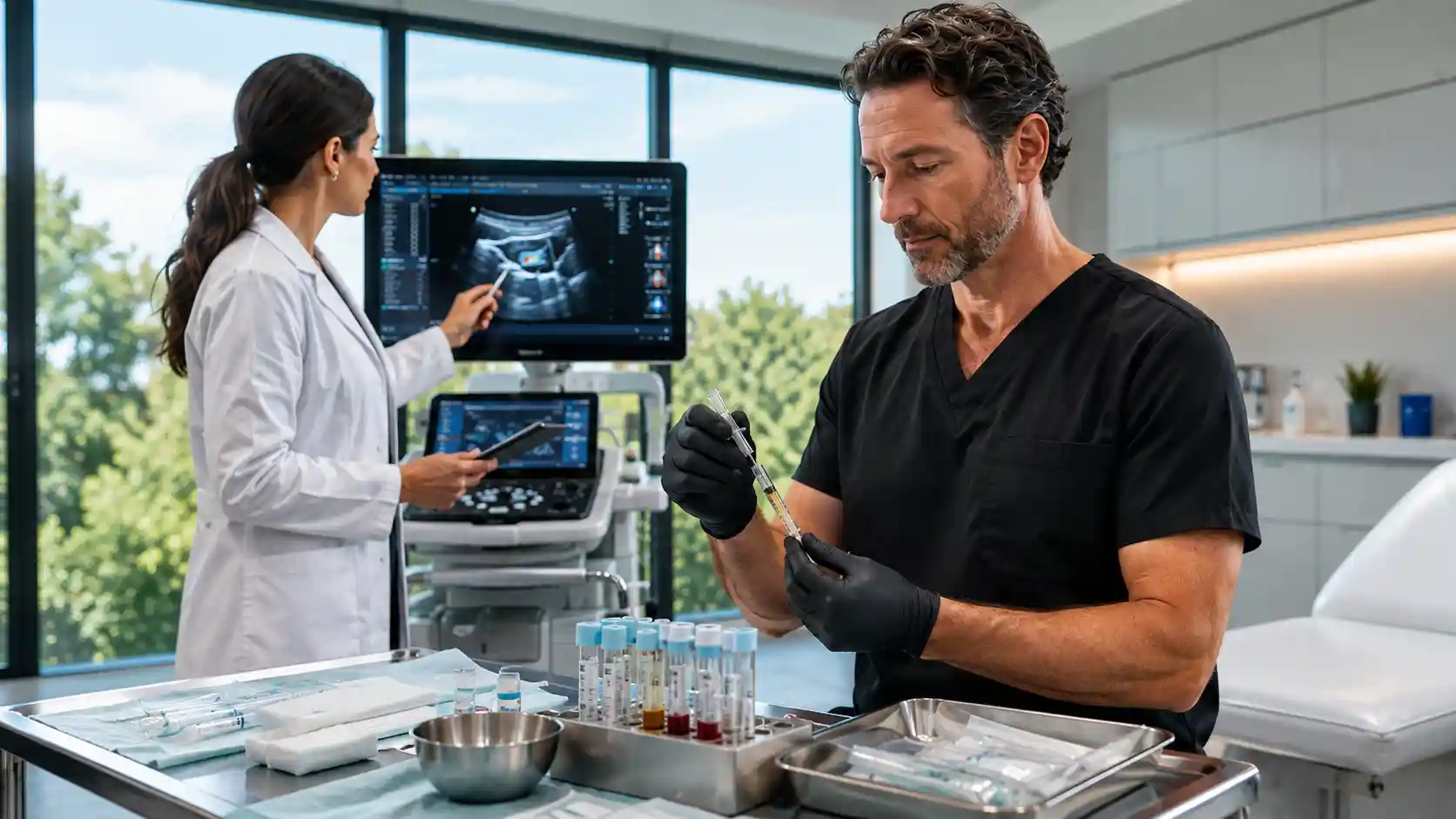
Workflow optimization involves evaluating each stage of a clinical process and identifying opportunities to make that process more efficient, consistent, and reliable.
In regenerative medicine, a workflow may include:
Rather than treating these steps as isolated tasks, practitioners can design them as a connected clinical pathway.
Consequently, workflow optimization can help reduce avoidable delays while ensuring that important clinical and documentation requirements remain part of the process.
Regenerative medicine procedures can involve multiple people, technologies, documentation requirements, and treatment steps. Without a clearly defined workflow, inconsistencies may develop.
For example, different members of a clinical team may interpret preparation procedures differently. Documentation may also vary between providers, making it more difficult to review treatment history and outcomes.
A standardized workflow can help create greater consistency.
An organized workflow allows the clinical team to prepare the necessary equipment, documentation, and treatment environment before the procedure begins.
This can minimize unnecessary interruptions and allow practitioners to focus on patient care.
Regenerative medicine procedures may involve physicians, nurses, medical assistants, laboratory personnel, and other healthcare professionals.
Clearly defined responsibilities can help everyone understand what needs to happen before, during, and after a procedure.
Documentation is an important component of responsible clinical practice.
A standardized documentation workflow can help capture relevant patient information, treatment details, procedural observations, and follow-up information in a consistent manner.
Patients benefit when clinical processes are organized.
Clear communication, predictable preparation steps, and appropriate follow-up can make the treatment experience easier to understand and navigate.
A practical workflow begins before the patient enters the treatment room.
The initial assessment should provide the practitioner with the information necessary to determine whether a particular regenerative medicine approach is appropriate.
The workflow can include standardized intake forms, medical history review, physical assessment, relevant diagnostic information, and documentation of treatment goals.
Treatment planning should connect the patient’s clinical presentation with the proposed intervention.
Rather than relying exclusively on informal communication, practices can use structured treatment-planning documentation to improve consistency between providers.
Equipment, supplies, documentation, and procedural materials should be prepared according to the practice’s established protocols.
A pre-procedure checklist can help the team verify that essential preparation steps have been completed.
Every member of the clinical team should understand their responsibilities.
For example, one team member may coordinate patient preparation while another assists the practitioner during the procedure.
Clear role allocation can reduce confusion and improve communication.
The procedure should be documented according to applicable clinical, legal, regulatory, and organizational requirements.
Documentation may include the treatment performed, relevant procedural details, patient response, and follow-up recommendations.
Follow-up should not be treated as an afterthought.
A complete regenerative medicine workflow includes a process for contacting the patient, evaluating outcomes, documenting observations, and determining whether additional clinical assessment is appropriate.
Technology can support workflow optimization when it is appropriately integrated into clinical practice.
Electronic medical records, digital consent systems, scheduling platforms, ultrasound imaging, procedural checklists, and standardized documentation templates can help connect different stages of the patient journey.
However, technology should support clinical decision-making rather than replace professional judgment.
The most effective systems are generally those that simplify essential tasks without creating unnecessary administrative complexity.
Technical knowledge is only one component of regenerative medicine education.
Practitioners also need to understand how individual clinical skills fit into a complete treatment pathway.
At IARM Training Services, regenerative medicine education can provide healthcare professionals with opportunities to develop practical knowledge while understanding how advanced regenerative approaches can be incorporated into clinical practice.
Training environments can also allow practitioners to examine procedural organization, patient communication, documentation, and clinical decision-making as interconnected components.
Workflow optimization should be measurable.
Practices can evaluate areas such as:
These measurements can help identify bottlenecks and determine whether workflow changes are producing meaningful improvements.
Importantly, efficiency should never be pursued at the expense of patient safety, clinical quality, or appropriate professional judgment.
Several challenges can interfere with efficient regenerative medicine workflows.
When procedures are performed differently by different team members, variation can increase.
Standard operating procedures and appropriate checklists can help establish greater consistency.
Incomplete handoffs can result in missing information or duplicated work.
Clear communication processes can reduce these problems.
Incomplete records can make it difficult to evaluate previous treatments and follow patient progress.
A structured documentation system can help address this issue.
Optimization does not mean adding more steps.
If a workflow contains unnecessary approvals, repetitive documentation, or redundant tasks, the system may become slower rather than better.
The objective should be simple, clear, repeatable, and clinically appropriate workflows.
As regenerative medicine continues to develop, clinical workflows will likely become increasingly data-driven and technology-supported.
Advanced imaging, digital health platforms, artificial intelligence, electronic documentation, and outcome-tracking systems may contribute to more connected clinical processes.
Nevertheless, technology alone will not create an effective workflow.
Successful implementation requires trained professionals, clearly defined responsibilities, appropriate protocols, accurate documentation, and continuous evaluation.
Workflow optimization for regenerative medicine procedures can help healthcare professionals create more organized and consistent clinical processes.
From patient assessment and treatment planning to procedure preparation, documentation, and follow-up, every stage contributes to the overall quality of care.
For practitioners entering or expanding their involvement in regenerative medicine, learning how to combine clinical knowledge with efficient workflow design can be an important component of professional development.
Ultimately, the goal is not simply to perform procedures faster. It is to create a safer, more consistent, better-documented, and patient-centered clinical experience.