
Regenerative medicine continues to transform modern healthcare by enabling the repair, replacement, or regeneration of damaged tissues and organs. At the center of this innovation are stem cells—unique biological units capable of self-renewal and differentiation. Understanding the different types of stem cells used in regenerative medicine is essential for clinicians, researchers, and healthcare professionals seeking advanced therapeutic strategies.
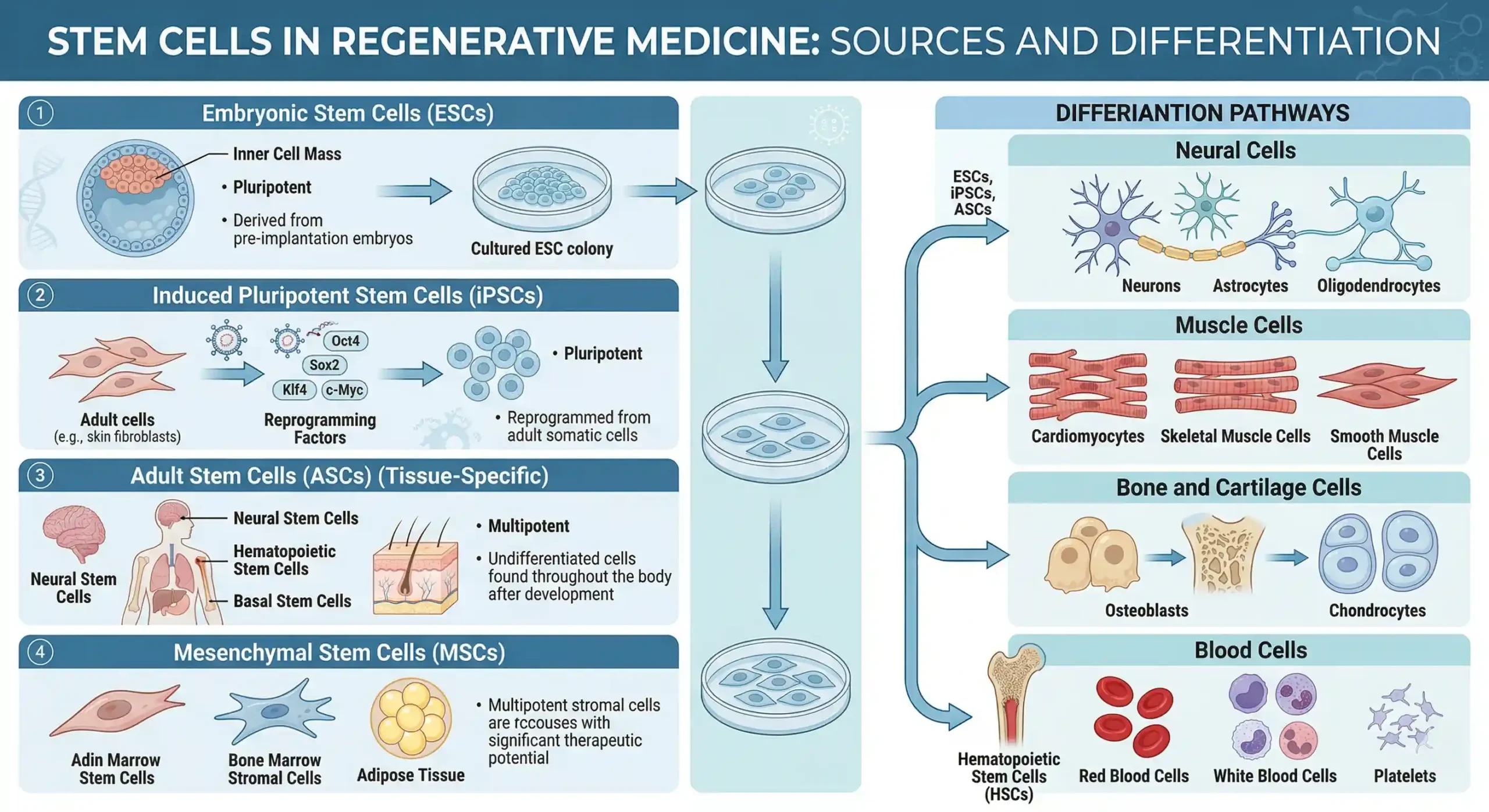
Regenerative medicine leverages the body’s natural healing mechanisms to restore function. Stem cells play a crucial role because they can develop into specialized cell types. As a result, they are widely used in clinical and research settings.
Moreover, advancements in stem cell biology continue to expand treatment possibilities. This field integrates biotechnology, cellular therapy, and tissue engineering to address complex medical conditions.
Embryonic stem cells are derived from early-stage embryos. These cells are pluripotent, meaning they can differentiate into nearly any cell type in the body.
ESCs are often used in:
However, ethical considerations and regulatory restrictions limit their widespread clinical use.
Adult stem cells are found in various tissues such as bone marrow and fat. Unlike embryonic stem cells, they are multipotent, meaning they can only develop into a limited range of cell types.
Adult stem cells are frequently used in:
These cells remain a cornerstone of regenerative medicine due to their safety profile.
Induced pluripotent stem cells are genetically reprogrammed adult cells that behave like embryonic stem cells. This breakthrough technology was pioneered by Shinya Yamanaka.
Additionally, iPSCs enable patient-specific therapies, which significantly improve treatment outcomes.
Mesenchymal stem cells are a subtype of adult stem cells commonly derived from bone marrow, adipose tissue, and umbilical cord tissue.
MSCs are widely used in:
Due to their versatility, MSCs are among the most utilized stem cells in regenerative medicine today.
Perinatal stem cells are obtained from birth-associated tissues such as the umbilical cord and placenta.
These cells offer a promising alternative to both embryonic and adult stem cells.
Understanding the types of stem cells used in regenerative medicine allows clinicians to:
Furthermore, each stem cell type presents unique advantages and limitations. Therefore, proper training and education are essential for effective application.
For advanced training and certification in regenerative medicine, visit IARM Training Programs
The field of regenerative medicine continues to evolve rapidly, driven by advances in stem cell research. From embryonic to induced pluripotent stem cells, each type plays a critical role in modern therapeutic approaches.
As innovation progresses, healthcare professionals must stay informed about the latest developments. Ultimately, mastering the different types of stem cells used in regenerative medicine will enhance clinical effectiveness and patient care.