Clinical confidence does not develop in theory alone. In regenerative medicine, confidence is built through direct experience, repetition, and guided clinical application. As regenerative therapies continue to expand across medical specialties, hands-on training has become essential for safe, effective, and ethical practice.
Unlike traditional lecture-based education, experiential learning allows clinicians to translate knowledge into real-world results. Therefore, hands-on regenerative medicine training plays a critical role in elevating both practitioner skill and patient outcomes.
Clinical confidence directly affects decision-making, procedural accuracy, and patient trust. In regenerative medicine, treatments often involve biologics, advanced protocols, and individualized care strategies. As a result, uncertainty can limit effectiveness.
When clinicians feel confident:
Procedures are performed with greater precision
Patient communication improves
Treatment planning becomes more accurate
Consequently, confidence supports both clinical excellence and professional credibility.
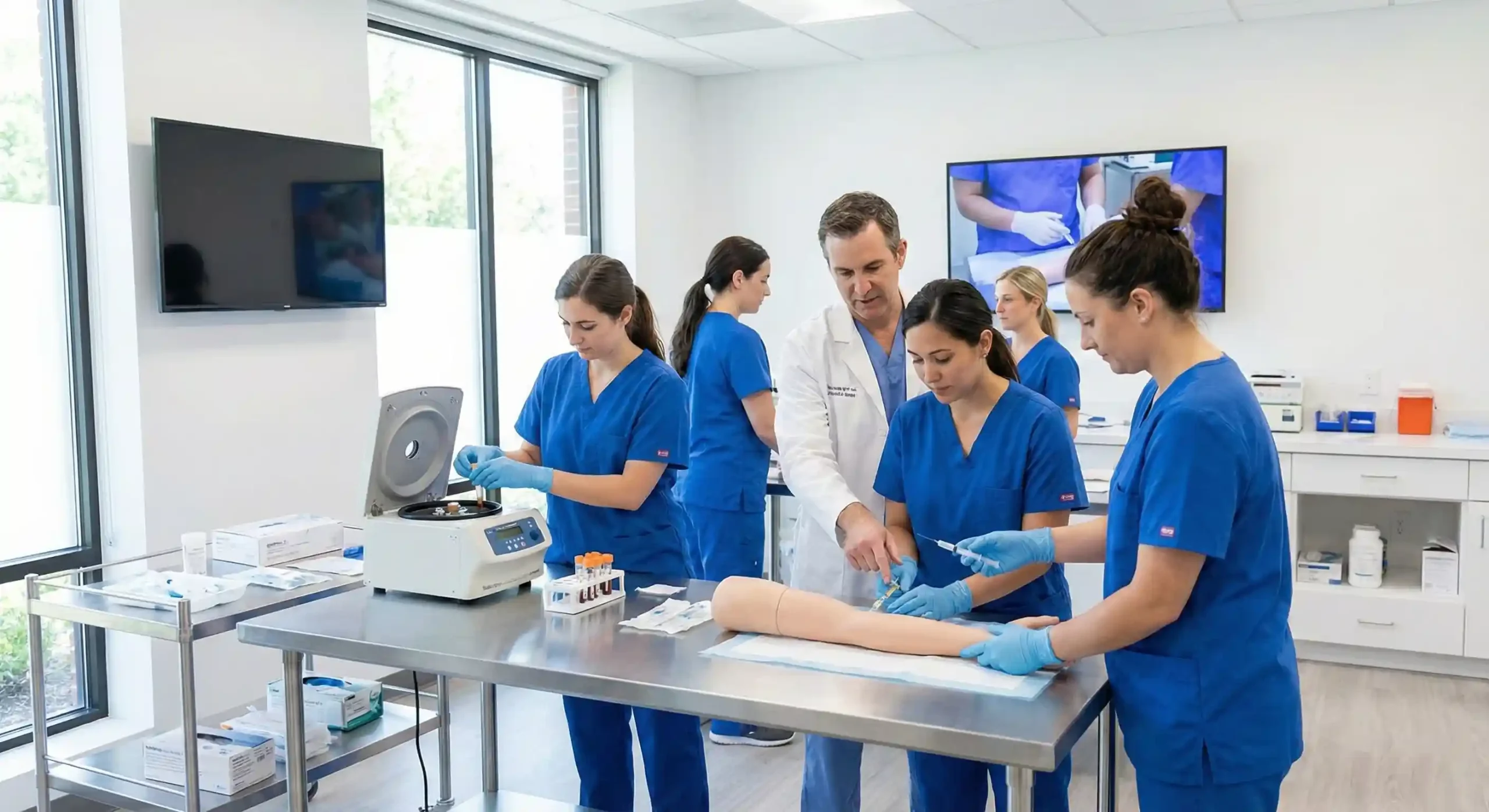
Hands-on regenerative medicine training bridges the gap between knowledge and execution. Instead of passive learning, clinicians actively participate in every stage of treatment delivery.
Live demonstrations with expert oversight
Supervised injections and procedures
Case-based learning using real patient scenarios
Immediate feedback and correction
As a result, clinicians gain muscle memory, clinical judgment, and procedural assurance.
The International Association of Regenerative Medicine (IARM) emphasizes applied education that mirrors real clinical environments. Through structured workshops and immersive programs, participants develop confidence through practice—not observation alone.
IARM’s approach ensures:
Evidence-based regenerative medicine protocols
Ethical and compliant clinical training
Skill progression aligned with real patient care
Learn more about IARM’s training philosophy at
IARM Official Website: https://iarm-usa.com/courses/
Many clinicians report that traditional continuing education lacks procedural depth. While theory remains important, regenerative medicine demands applied competence.
Hands-on regenerative medicine training helps clinicians:
Reduce hesitation during procedures
Apply protocols correctly from day one
Improve consistency in patient outcomes
Therefore, confidence is not assumed—it is earned through repetition and mentorship.
Several studies support experiential medical education as a driver of clinical competence:
Harvard Medical School – Experiential Learning in Clinical Education
https://hms.harvard.edu/education
National Institutes of Health – Regenerative Medicine Overview
https://www.nih.gov/research-training/medical-research-initiatives/regenerative-medicine
These sources reinforce the importance of structured, hands-on training in advanced medical fields.
As regenerative medicine continues to evolve, hands-on education will remain the gold standard. Clinicians who invest in experiential learning position themselves for long-term success, improved outcomes, and professional leadership.
Ultimately, clinical confidence grows when training reflects reality—and hands-on regenerative medicine education delivers exactly that.